Beyond the Machine: How Holistic Concepts Are Transforming Additive Serial Production
The Path to Intelligent LPBF Manufacturing Processes
The industrial production landscape is constantly evolving, and with it the demands placed on modern manufacturing technologies. Additive manufacturing – particularly laser powder bed fusion (LPBF) – has long progressed from prototyping to becoming a key technology for series production.
However, this progress brings new challenges: it requires more than just high-performance machines. What is needed are integrated solutions that enable seamless interaction between machine architecture, precise process control, and full-scale production capability. Central to this are the drastic reduction of setup times, ensuring reproducibility of every component, and complete traceability throughout the entire production cycle. The answer lies in innovative system approaches that can be modularly adapted and flexibly configured for a wide range of applications.
Precision and Reliability: The Foundation for Series Quality
The industrial application of additive processes such as LPBF requires maximum process control. Components must not only be produced with consistent quality, but machines must also be efficiently utilized while complying with strict safety standards. Martin Buscher, Head of Testing Facilities at Aconity3D GmbH, a leading developer and manufacturer of modular LPBF machines, emphasizes the sensitivity of the process:
“Even the slightest deviations in temperature control or energy input can alter material properties. Therefore, it is crucial that the process can be precisely controlled and that the machine structure enables this in series production.”
Reproducibility is a particular challenge. Unlike conventional methods, where material properties stem from pre-manufactured semi-finished products, in LPBF they are created directly during the manufacturing process. Every parameter—from exposure strategy to shielding gas flow—can influence the final result. For series production, this requires deep process understanding, advanced technological tools, and comprehensive validation through detailed machine and process data.
Efficiency Through Intelligent Modularity: Minimizing Setup Times
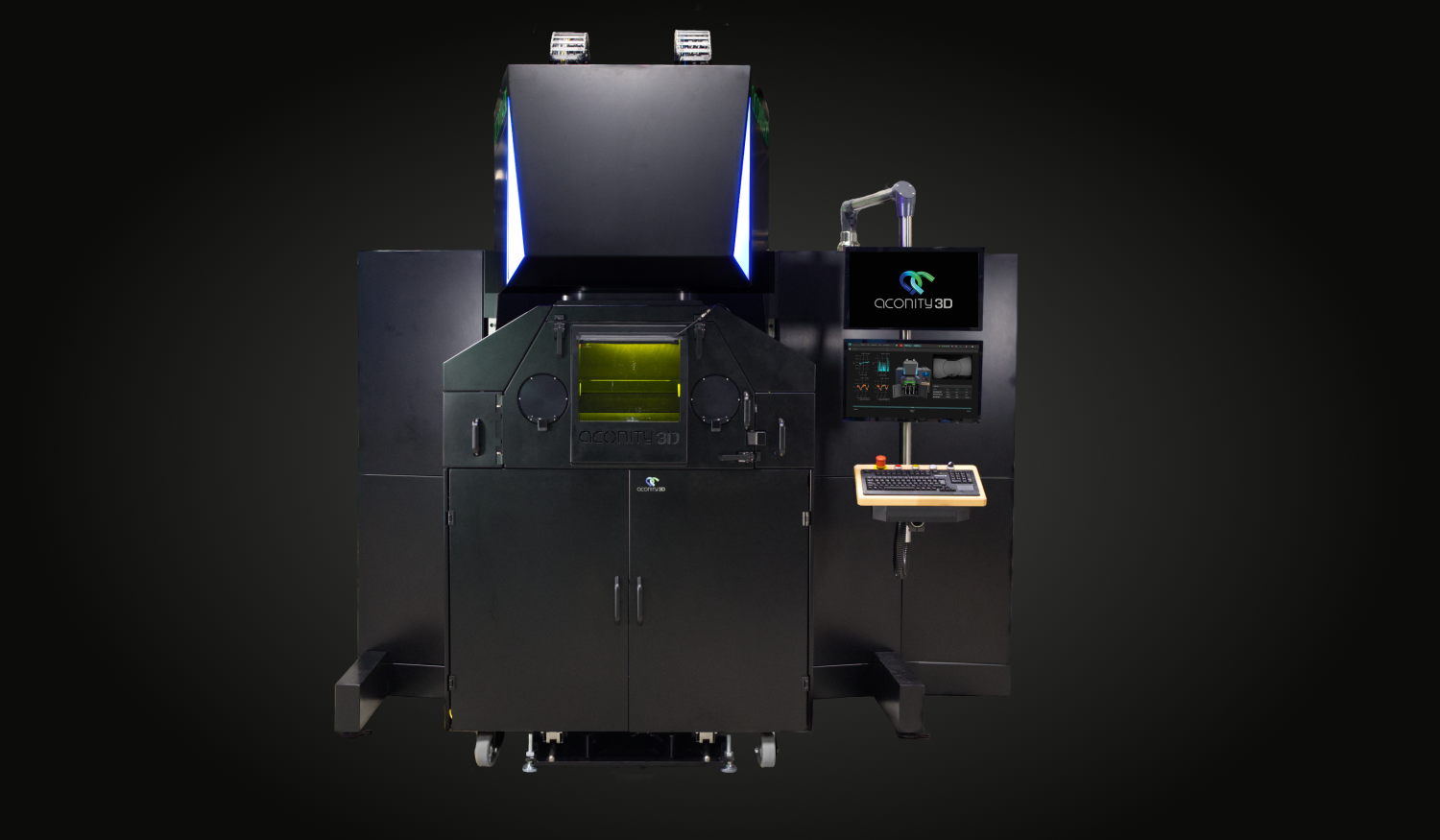
A key advantage for productivity lies in the modular architecture of modern LPBF systems such as the AconityX. The ability to exchange the process chamber allows additional chambers to be prepared or cleaned in parallel with the main process. This reduces downtime to an absolute minimum—a critical factor for overall efficiency. In addition, an innovative modular filter system ensures safe and low-maintenance disposal of soot and filter residues.
“Conventional filter elements need frequent replacement and pose safety risks due to metallic residues. The new filter system not only extends maintenance intervals but also ensures safe handling of these by-products,” explains Buscher.
The consistent separation of process modules from the system core also optimizes maintenance procedures. Individual components such as optics, beam sources, or control units are separately accessible and can be replaced as needed. This saves valuable time, reduces maintenance complexity, and significantly increases overall equipment effectiveness in LPBF operations.
Scalable Laser Power: Redefining Productivity
Another lever for increasing productivity is the flexible laser architecture of the AconityX. Depending on the application, up to six high-performance lasers with up to 4 kW each can be combined. An internal project also demonstrated that replacing a standard laser with a more powerful variant reduced production time by 40% and enabled the production of an additional 1,300 LPBF components per year at constant overall costs.
“This power density with just one laser significantly increases efficiency while also reducing failure risk, which is much higher in machines with multiple parallel lasers,” says Buscher.
The scalable architecture also ensures that production machines like the AconityX can be precisely adapted to changing requirements. Companies can start with a base configuration and retrofit additional laser sources, heating modules, or monitoring systems during operation. This is a decisive feature, especially for manufacturers with growth ambitions.
Specialization Through Flexible Process Modules: Tailored Solutions
The ability to meet individual requirements across different industries is enabled by variable beam profiles and specific process chambers. Materials such as copper, steel, or aluminum can be processed contamination-free in dedicated chambers without requiring additional machines. Ultra-fast purging further optimizes efficiency by rapidly inerting the chamber and reducing non-productive time.
Moreover, the ability to store both validated standard parameters and customer-specific process settings—and retrieve them automatically—makes material changes safer and more efficient. Integrated user management combined with RFID-based identification of process chambers ensures that the correct parameters are always used. This creates a clear competitive advantage, particularly in applications involving multiple materials and strict documentation requirements.
Robust Design for Industrial Environments
The deployed solutions must withstand real production conditions. Buscher emphasizes the importance of robust machine design:
“Industrial environments are far from sterile. High temperatures, dust, and vibrations are part of daily operations. Therefore, LPBF machines must be designed with robustness in mind, for example through encapsulated optics and stable thermal management.”
Ease of use is equally essential. The control panel is clearly structured so that key process data can be captured at a glance, and maintenance points are ergonomically accessible. Seamless integration into existing production lines—e.g., via standardized automation interfaces—is also crucial.
Data as a Value Driver: Quality Assurance and Optimization
In addition to hardware, software plays a decisive role in process stability. Using systems such as AconitySTUDIO and integrated monitoring solutions like AconityANALYZE, all process parameters can be fully recorded, stored, and visualized—from oxygen levels and temperature curves to gas flow velocity.
“These data form the basis for certified processes in series production. Without transparency, there is no compliance,” Buscher explains.
The collected data support both internal quality assurance and external audits. In regulated industries such as aerospace or medical technology, they are indispensable. In the long term, they also enable the development of digital twins for predictive process optimization.
Calculating Economic Efficiency: Simulation for the Business Case
Rapid determination of application-specific machine configurations also contributes significantly to efficiency. With tools such as a business case calculator, system design and production planning can be economically optimized.
“It takes into account production scenarios, shift models, and component geometries to calculate which combination of lasers, chambers, and setup cycles delivers the best output,” explains Buscher.
The methodology combines economic metrics with physical process parameters, providing companies with a solid basis for investment decisions and ROI calculations. It also supports strategies for future expansion and gradual automation.
Practical Examples: Cross-Industry Success
The advantages of these holistic approaches are already evident across industries such as aerospace, medical technology, and electromobility. For example, the additive production of hairpin winding heads for electric motors eliminates the need for costly tooling—significantly improving efficiency, especially in prototyping and small series.
Another example from Aconity3D’s own machine park highlights the potential: the so-called galvo carrier—an aluminum component of the beam deflection system—was additively optimized and now enables significant time savings when used with a new laser source.
“It should be our goal that more users benefit from such experience,” says Buscher.
Knowledge Transfer as a Key to Success: Digital Training Concepts
“First, companies need a sustainable entry into additive series production. A system that grows and adapts to new requirements can provide an important foundation,” explains Buscher. Manufacturers benefit from partners along the entire additive process chain, especially those offering training opportunities.
Company academies provide free access to video training, live sessions, and tutorials. The content covers not only technical topics but also best practices, process stabilization, and safe material handling—enabling an accessible entry point even for companies with little prior experience.
Conclusion
The transformation of industrial series production through additive LPBF processes goes far beyond machine performance. Key success factors today include modularity, comprehensive process stability, safe handling, and economic scalability. Modern system concepts such as the AconityX offer the flexibility needed to meet dynamic requirements and secure long-term investments.
Supported by continuous monitoring, intelligent parameter and material management, and accessible digital training, additive manufacturing is becoming a cornerstone of future-ready production strategies. Companies that embrace such integrated and advanced solutions not only achieve significant efficiency gains but also secure a leading technological position in an ever-evolving market.
Author: Nadja Müller, journalist for Wordfinder
Configure your AconityX now: https://aconity3d.com/de/products/aconity-x/