How new systems are setting benchmarks in productivity, precision, and process freedom
Rethinking efficiency: Economic advantages of wire-based processes
Wire-based additive manufacturing is increasingly evolving into an industrially relevant alternative to powder bed processes (Laser Powder Bed Fusion, L-PBF). It particularly demonstrates its strengths in large-volume components, special alloys, or cost-critical applications: high deposition rates, simple handling, and material efficiency.
New generations of systems now also provide the precision and automation required for industrial series production.
Limits of conventional powder bed processes
Powder bed-based processes such as laser powder bed fusion have been considered the technological benchmark in metal additive manufacturing for years. However, when it comes to large-volume components, high production volumes, or special alloys, they are currently reaching physical and economic limits. Handling large quantities of powder, inerting entire process chambers, and the associated energy and safety requirements increase both complexity and cost. In addition, the process architecture limits the maximum build volume and complicates the use of certain alloys that are not always available as powders or are difficult to process.
Additive manufacturing with wire: A flexible alternative
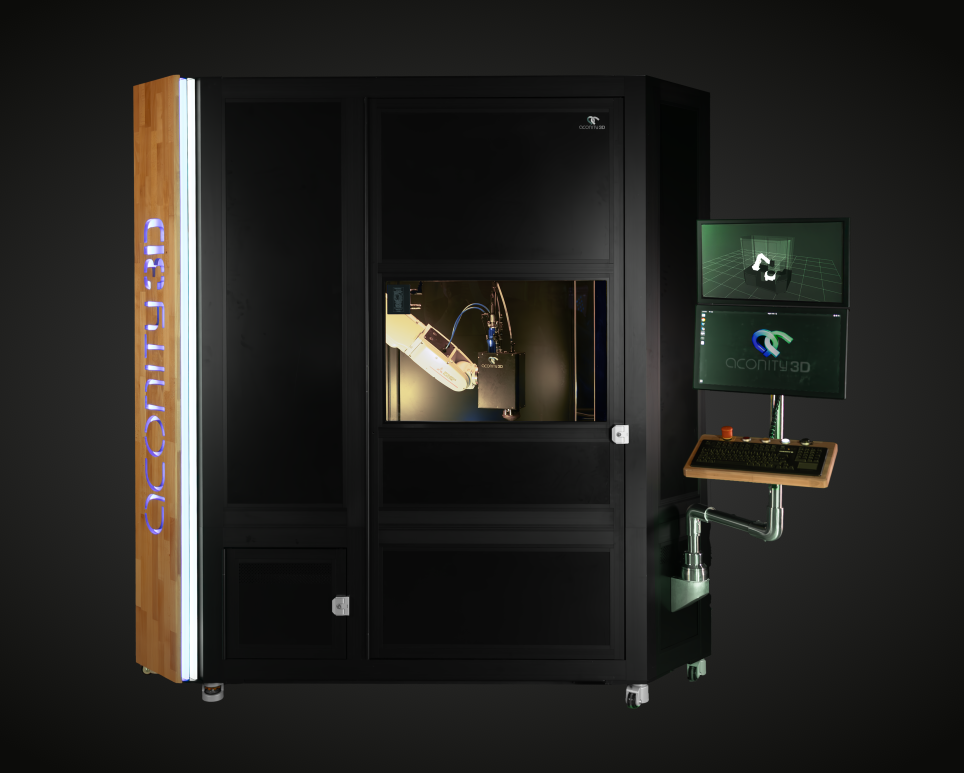
To overcome these challenges, innovative approaches are needed that offer alternatives to metal powder as a starting material. With the development of systems such as the AconityWIRE, Aconity3D GmbH from Aachen has created a new generation of machines that consistently harness the potential of wire-based additive manufacturing for industrial applications. The system combines high deposition rates and process speed with the precision and controllability previously known only from powder bed processes. This creates a bridge between the two worlds—from research to series production.
“With wire-based manufacturing, the gap between high-resolution powder bed processes and traditional welding processes is closing,” explains Michael Stockschläder, Application Development at Aconity3D. “Laser wire deposition—Wire-LMD—combines high process speed with precise layer control and excellent material efficiency.”
In contrast to powder-based systems, complex powder handling is eliminated. Standard welding wires serve as the feedstock; they are inexpensive, readily available, and safe to handle. Thanks to localized shielding gas flow, the manufacturing process can begin almost immediately after inserting the substrate, without the need for large-scale chamber inerting. This significantly reduces setup time while simultaneously increasing process stability.
Balancing precision and productivity
ith the AconityWIRE, a machine is available that combines the advantages of wire-based processes with the requirements of industrial manufacturing. The cylindrical build volume of 400 mm in diameter and 780 mm in height covers a wide range of applications, making it suitable for both research institutions and industrial production environments. A six-axis robotic arm combined with a tilt-and-rotate table enables entirely new process strategies.
“This freedom of movement is a decisive factor,” says Stockschläder. “It allows geometries that would be difficult to realize with powder bed processes, such as complex curved structures, contour-following builds, or variable layer heights within a single build process. This opens up entirely new design possibilities for designers and engineers.”
Focus on cost-effectiveness and sustainability
The AconityWIRE is consistently designed for efficiency. High deposition rates and near-complete material utilization enable components to be manufactured significantly faster and more cost-effectively than with L-PBF processes. Eliminating powder handling and inerting reduces operating costs, energy consumption, and maintenance requirements considerably, while also lowering occupational safety demands.
The system is also compatible with common G-code formats and CAM systems, simplifying integration into existing manufacturing workflows. “For many users, this can be a gateway into additive manufacturing,” explains Stockschläder. “They can work with familiar materials and data formats without requiring extensive training or expensive specialized materials.”
Furthermore, the technology contributes to resource conservation. Near 100 % material utilization and the energy efficiency of the laser source result in a significantly smaller ecological footprint. This makes wire-based additive manufacturing particularly attractive for companies pursuing sustainability as a strategic goal.
Real-time process monitoring and quality assurance
To ensure high process stability, the AconityWIRE features integrated sensor technology, including wire contact and wire force monitoring, optional pyrometry for emission measurement, and monitoring cameras that continuously document the process. The data can be evaluated in real time and used for automated control and downstream quality assurance.
“For many industrial users, documentation is a key requirement,” emphasizes Stockschläder. “The system is capable of recording all relevant process parameters and enables traceability down to the individual track level. This creates the basis for reproducible results and certification, which is an essential step toward series production.”
Materials, applications, and automation
The AconityWIRE processes standard welding wires with diameters ranging from 0.6 to 1.2 mm, including stainless steel, Inconel, titanium, and aluminum. A special feature is its multi-material capability, allowing automatic wire changes between different materials. This makes the machine suitable not only for building new components but also for repair and remanufacturing processes, for example in aerospace or toolmaking.
One application example is the repair of turbine blades, where worn areas can be rebuilt additively. In energy technology and mechanical engineering, wear-prone components can also be economically restored using wire-based additive manufacturing. “There is great potential in remanufacturing,” explains Stockschläder. “Worn areas of otherwise functional components can be selectively rebuilt and returned to the production cycle, contributing to sustainability and the circular economy.”
In combination with software solutions such as OpenARMS from BCT GmbH, 3D scans can be planned, executed automatically, and evaluated. Repair strategies can also be calculated automatically, and G-code files executed directly. This results in a fully automated process chain for additive manufacturing, repair, and coating of components.
Safety and modular expandability
For industrial operation, the AconityWIRE meets high safety standards: a fully enclosed process chamber, laser protection mechanisms, light barriers, and integrated filtration and extraction systems ensure safe operation. The entire working area is continuously monitored. Another advantage is its modular architecture, which allows for individual customization and expansion.
“The system is not static,” emphasizes Stockschläder. “It grows with user requirements. Additional sensors, software modules, or automation functions can be integrated at any time in line with an open machine philosophy.”
Perspectives for research and industry
The AconityWIRE is the first Directed Energy Deposition (DED) system in Aconity3D’s product portfolio, addressing the gap between open process research and robust repair or deposition processes.
The system allows intervention in process parameters (e.g., laser power and wire feed) as well as access to raw and sensor data via documented interfaces. It is already in use at several research institutions, including Rosenheim Technical University, where additive repair processes and multi-material builds are being investigated.
Conclusion
The AconityWIRE closes a technological gap between powder bed processes and conventional DED systems. With its high productivity, flexible process control, and user-friendly integration into existing manufacturing environments, it provides a practical entry point into wire-based additive manufacturing. Its openness to materials, processes, and software solutions makes it a future-proof platform for research, development, and industrial series production alike. As such, it makes a significant contribution to advancing additive manufacturing toward greater efficiency, automation, and sustainability.
Author: Patrick Schulze, journalist for Wordfinder
Configure your AconityWIRE now: https://configurator.aconity3d.com/EN/units/AconityWIRE